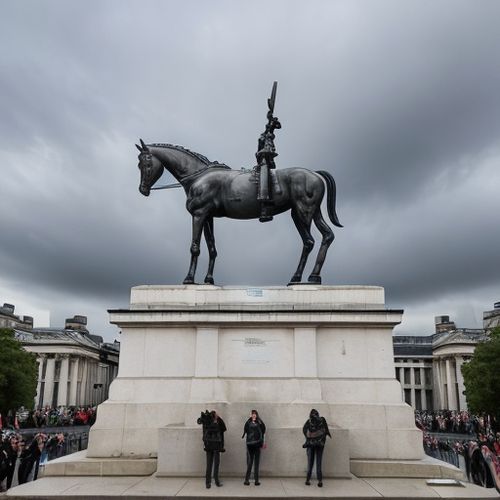
The iconic Fourth Plinth in London’s Trafalgar Square has long been a platform for provocative and thought-provoking contemporary art. This year, it unveils a monumental new addition: a colossal sculpture entirely generated by artificial intelligence. The piece, titled "The Infinite Echo," marks a bold departure from traditional public art, challenging perceptions of creativity, authorship, and the role of technology in shaping our cultural landscape.
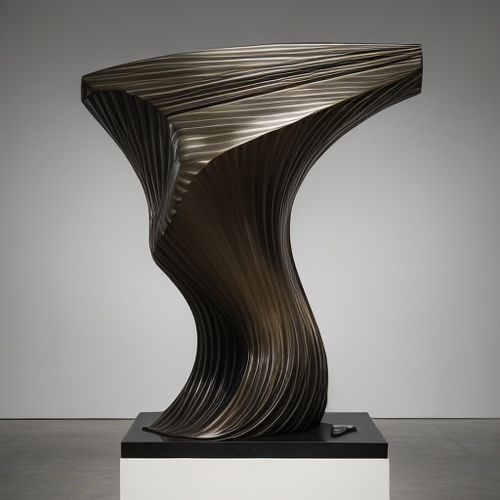
Created by a collaborative team of artists, programmers, and AI researchers, "The Infinite Echo" is the first AI-generated artwork to occupy the prestigious plinth. The sculpture’s form—a swirling, fractal-like structure of interlocking geometries—was conceived through a complex algorithm trained on centuries of sculptural history, from classical marble statues to modernist abstractions. The result is a mesmerizing hybrid, both familiar and utterly alien, that seems to shift in meaning depending on the viewer’s perspective.
A Controversial Leap into the Future
Reactions to the installation have been polarized. Supporters hail it as a visionary step forward, embracing AI as a legitimate creative partner. "This isn’t about replacing human artists," says curator Dr. Elara Voss. "It’s about expanding the boundaries of what art can be. The AI didn’t work in isolation—it was guided by human intent, trained on human culture, and physically realized by human hands." Critics, however, argue that the piece undermines the very essence of artistic expression. Prominent art historian Richard Byrne dismissed it as "a glorified screensaver," questioning whether algorithmically assembled forms can truly carry emotional or intellectual weight.
The debate extends beyond aesthetics. "The Infinite Echo" raises pressing questions about originality in the age of machine learning. Its algorithm was fed thousands of images of existing sculptures, leading some to accuse it of being "high-tech plagiarism." The artists counter that all art is in dialogue with what came before—the AI simply accelerates and recombines those conversations in unexpected ways.
Technical Marvel Meets Political Statement
Beyond its striking appearance, the sculpture functions as a technological showcase. Its surface, made of lightweight aerospace-grade alloys, was 3D-printed in sections using robotic arms—a process that would have been impossible a decade ago. Embedded sensors allow the structure to respond subtly to weather patterns, with surface textures shifting minutely under rain or sunlight. At night, bioluminescent coatings emit a faint glow, making the plinth appear alive.
Some observers detect a deliberate political subtext. The Fourth Plinth has historically hosted works commenting on power and memory, from Katharina Fritsch’s giant blue rooster to Heather Phillipson’s whipped cream topped with a drone. "The Infinite Echo" continues this tradition, its ever-mutating form serving as a metaphor for the instability of truth in our algorithm-driven era. "It reflects how technology distorts and reconstructs reality," notes cultural critic Priya Mehta. "We’re all being shaped by invisible systems—this makes them visible."
Public Engagement and the Ghost in the Machine
Unlike previous Fourth Plinth installations, viewers can interact with the artwork’s creation process. Via a dedicated app, they submit words or images that temporarily influence the sculpture’s lighting patterns. This participatory element has proven wildly popular, with over 250,000 contributions in the first week alone. However, it’s also sparked concerns about surveillance capitalism, as the app collects anonymized data on user preferences.
The most haunting aspect may be the work’s elusive "personality." Despite being non-sentient, the AI’s design choices—unpredictable but not random—create an uncanny impression of intention. "Sometimes it feels like there’s something looking back at you," remarked one visitor. This phenomenon, dubbed "the ghost in the machine" by the project team, blurs the line between tool and creator in unsettling ways.
Legacy and the Next Frontier
Whether celebrated or scorned, "The Infinite Echo" undeniably pushes public art into uncharted territory. Its 18-month tenure on the plinth will likely influence how museums and institutions approach AI collaborations. Early indications suggest it’s already inspiring a wave of hybrid human-machine projects, from algorithmically generated poetry murals to virtual reality sculptures that evolve in real time.
As the sun sets over Trafalgar Square, the sculpture’s luminous contours seem to dissolve and reform against the London skyline. It stands as both an artifact of our moment—a time of breakneck technological change—and a challenge to imagine what might come next. The Fourth Plinth was once reserved for kings and generals; now, it belongs to the age of machines that dream.
By Sophia Lewis/Apr 12, 2025
By Victoria Gonzalez/Apr 12, 2025
By Olivia Reed/Apr 12, 2025
By Sophia Lewis/Apr 12, 2025

By Megan Clark/Apr 12, 2025
By Emily Johnson/Apr 12, 2025
By Benjamin Evans/Apr 12, 2025
By Rebecca Stewart/Apr 12, 2025
By Grace Cox/Apr 12, 2025
By Grace Cox/Apr 12, 2025
By Sarah Davis/Apr 12, 2025
By Emma Thompson/Apr 12, 2025
By Michael Brown/Apr 12, 2025
By Lily Simpson/Apr 12, 2025

By John Smith/Apr 12, 2025
By Lily Simpson/Apr 12, 2025
By Rebecca Stewart/Apr 12, 2025
By Emily Johnson/Apr 12, 2025
By Natalie Campbell/Apr 12, 2025
By Jessica Lee/Apr 12, 2025