The abstract expressionist movement, which emerged in post-World War II America, has long been a subject of intense scrutiny—not just for its radical departure from traditional artistic conventions, but also for the political narratives that have been woven around it. While some argue that the movement was a covert tool of Cold War propaganda, others insist that its political significance has been exaggerated, if not entirely fabricated. The debate raises a critical question: has the political metaphor in abstract expressionism been overinterpreted?
At the heart of this controversy lies the relationship between abstract expressionism and the U.S. government during the Cold War. Historians like Frances Stonor Saunders have posited that the CIA secretly promoted abstract expressionism as a symbol of American freedom and creativity, contrasting it with the rigid, state-controlled art of the Soviet Union. This theory gained traction in the 1990s when declassified documents hinted at covert cultural campaigns. Yet, the extent to which abstract expressionist artists were complicit—or even aware—of these alleged machinations remains murky. Artists like Jackson Pollock and Mark Rothko rarely spoke of their work in overtly political terms, leaving room for interpretation.
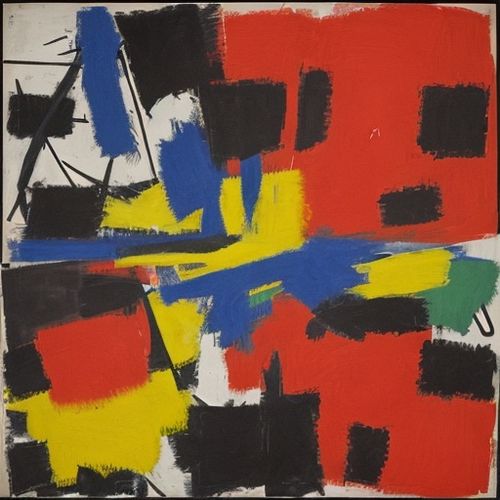
Critics of the overinterpretation argument point out that abstract expressionism was, first and foremost, an artistic revolution. The movement’s pioneers sought to break free from representational art, exploring the subconscious, emotion, and pure form. To reduce their work to political symbolism, they argue, is to overlook its intrinsic aesthetic and philosophical value. Rothko’s luminous color fields, for instance, were deeply personal explorations of human emotion, not calculated statements about American ideology. Similarly, Pollock’s chaotic drips and splatters were more about the act of creation itself than any hidden geopolitical agenda.
Nevertheless, the allure of political metaphor is hard to resist. Abstract expressionism’s rise coincided with America’s cultural ascendancy on the global stage, and its embrace by institutions like the Museum of Modern Art (MoMA) lent credence to the idea that it was being weaponized as soft power. The movement’s emphasis on individualism and freedom could be read as a rebuke to Soviet collectivism, even if that wasn’t the artists’ explicit intent. This ambiguity is precisely what fuels the debate: when art becomes entangled with historical context, where does the artist’s vision end and the critic’s projection begin?
Some scholars have taken a middle ground, acknowledging that while abstract expressionism wasn’t conceived as propaganda, its reception and institutional support may have politicized it retroactively. The U.S. government didn’t need to dictate the movement’s content for it to serve a political function; the mere fact that it flourished in America was enough to make it a cultural battleground. In this view, the overinterpretation isn’t entirely unfounded—it’s just misplaced. The politics weren’t in the paintings; they were in the way the paintings were framed by critics, curators, and Cold War ideologues.
Ultimately, the question of whether abstract expressionism’s political metaphor has been overinterpreted may miss the point. Art is inherently polysemic, capable of carrying multiple meanings depending on who’s looking and when. What matters is not whether the political readings are "correct," but why they persist—and what they reveal about the enduring fascination with art as a mirror of its time. The abstract expressionists may not have set out to wage a cultural Cold War, but their work, like all great art, became a canvas for the anxieties and aspirations of an era.
By Sophia Lewis/Apr 12, 2025
By Victoria Gonzalez/Apr 12, 2025
By Olivia Reed/Apr 12, 2025
By Sophia Lewis/Apr 12, 2025
By Megan Clark/Apr 12, 2025
By Emily Johnson/Apr 12, 2025
By Benjamin Evans/Apr 12, 2025
By Rebecca Stewart/Apr 12, 2025
By Grace Cox/Apr 12, 2025
By Grace Cox/Apr 12, 2025
By Sarah Davis/Apr 12, 2025
By Emma Thompson/Apr 12, 2025
By Michael Brown/Apr 12, 2025
By Lily Simpson/Apr 12, 2025

By John Smith/Apr 12, 2025
By Lily Simpson/Apr 12, 2025
By Rebecca Stewart/Apr 12, 2025

By Emily Johnson/Apr 12, 2025
By Natalie Campbell/Apr 12, 2025
By Jessica Lee/Apr 12, 2025