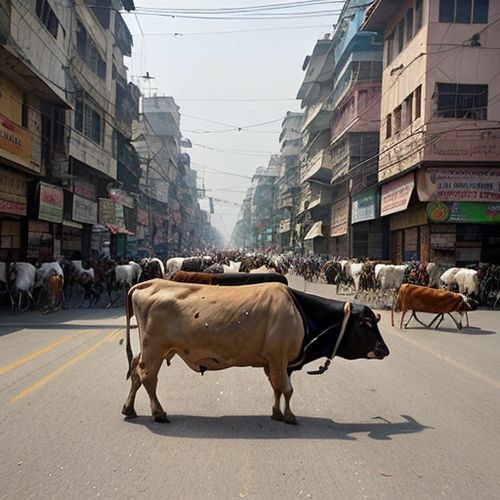
In the bustling streets of India, where vehicles, pedestrians, and animals often share the same space, one peculiar yet culturally significant phenomenon stands out: the practice of cattle yielding. Unlike Western countries where traffic rules prioritize vehicles, Indian roads frequently witness drivers patiently maneuvering around cows that leisurely occupy thoroughfares. This unique interaction between humans and bovines reflects deeper socio-religious complexities that defy conventional urban planning logic.
The sacred status of cows in Hinduism forms the bedrock of this cultural practice. Considered embodiments of the divine and symbols of non-violence, cattle enjoy unparalleled protection under both religious doctrine and secular laws in many Indian states. Slaughtering cows remains banned in several regions, while vehicular accidents involving bovines often escalate into legal or even vigilante disputes. This reverence translates into everyday scenarios where drivers—regardless of urgency—will honk gently, swerve carefully, or simply wait rather than disturb resting cattle.
Urban infrastructure struggles to reconcile modern traffic management with this ancient tradition. Major cities like Delhi, Mumbai, and Bangalore witness daily traffic snarls caused by free-roaming cattle, particularly near temple areas or dairy colonies. Municipal corporations have attempted solutions ranging from cattle shelters to RFID tagging, yet implementation remains inconsistent. The tension between preserving cultural values and ensuring road safety sparks continuous debate among policymakers, religious leaders, and urban planners.
Economic realities further complicate the cattle conundrum. Stray bovines often belong to impoverished dairy farmers who cannot afford proper shelters, releasing animals to fend for themselves after their milk-producing years. These aging creatures instinctively gravitate toward roads where food waste abounds near markets and restaurants. The sight of cows rummaging through garbage piles while Mercedes sedans inch past them encapsulates India's jarring economic contrasts and the unintended consequences of rapid urbanization.
Technological adaptations have emerged organically to address this challenge. Truck manufacturers now install extended bumpers colloquially called "cattle guards," while ride-sharing apps incorporate cattle-prone zones into navigation algorithms. Some traffic police units employ specialized "cattle patrols" equipped with feed and ropes to gently relocate strays. These innovations demonstrate how Indian society negotiates between tradition and modernity through grassroots problem-solving rather than top-down enforcement.
The psychological dimension of cattle yielding reveals fascinating behavioral patterns. Long-term exposure to bovine roadblocks has conditioned Indian drivers to develop extraordinary patience and spatial awareness. Neurological studies suggest such daily navigational challenges may enhance certain cognitive abilities related to hazard perception. Conversely, foreign visitors often experience culture shock when encountering their first cow-jam, with some requiring specialized "road culture" briefings from rental car agencies.
Environmentalists highlight an unexpected silver lining—the slowing effect of cattle on traffic actually reduces emissions in congested areas. The involuntary speed bumps created by lounging livestock force vehicles to maintain lower speeds, paradoxically aligning with global sustainable urban mobility goals. This incidental benefit underscores how traditional practices sometimes accidentally address modern problems through unorthodox means.
Legal frameworks surrounding cattle-related accidents present a labyrinth of contradictions. While motorists bear responsibility for collisions under standard traffic laws, special provisions exist for bovine incidents. Insurance claims frequently hinge on whether the animal was properly tagged or belonged to identifiable owners. Nighttime accidents pose particular challenges, as stray cattle often sleep on warm asphalt roads during cooler months, becoming virtually invisible to drivers.
The phenomenon has birthed an entire subculture of road etiquette. Seasoned drivers develop an almost sixth sense for detecting cattle behavior—recognizing the flick of a tail or ear movement as signals of impending movement. Truckers communicate bovine locations via CB radio, while street vendors sometimes act as impromptu cattle wardens by shooing animals away from dangerous intersections. This collective guardianship reflects the communal approach to problem-solving prevalent in Indian society.
Tourism sectors have begun leveraging this quirk as part of India's cultural branding. Luxury travel agencies now offer "Cow Spotting" tours for foreign visitors, complete with photographic guides to different cattle breeds commonly seen on roads. Social media brims with viral videos capturing humorous or heartwarming cattle-vehicle interactions, further cementing the cow's status as an unofficial mascot of Indian roadways.
As India accelerates toward becoming the world's third-largest economy, the cattle conundrum persists as a litmus test for balancing progress with tradition. Smart city initiatives propose high-tech solutions like AI-powered cattle detection systems, while rural communities advocate for preserving the organic human-animal coexistence. Whatever solutions emerge, the humble cow will likely continue its reign as the most respected—if unpredictable—traffic regulator on Indian roads for generations to come.
By Thomas Roberts/Apr 14, 2025

By Laura Wilson/Apr 14, 2025

By Jessica Lee/Apr 14, 2025

By Benjamin Evans/Apr 14, 2025

By George Bailey/Apr 14, 2025

By Emma Thompson/Apr 14, 2025

By John Smith/Apr 14, 2025

By Michael Brown/Apr 14, 2025

By Megan Clark/Apr 14, 2025

By Jessica Lee/Apr 14, 2025

By Sarah Davis/Apr 14, 2025

By Laura Wilson/Apr 14, 2025

By Sophia Lewis/Apr 14, 2025

By Natalie Campbell/Apr 14, 2025

By Eric Ward/Apr 14, 2025

By Laura Wilson/Apr 14, 2025

By Sophia Lewis/Apr 14, 2025

By George Bailey/Apr 14, 2025

By Laura Wilson/Apr 14, 2025

By Daniel Scott/Apr 14, 2025